
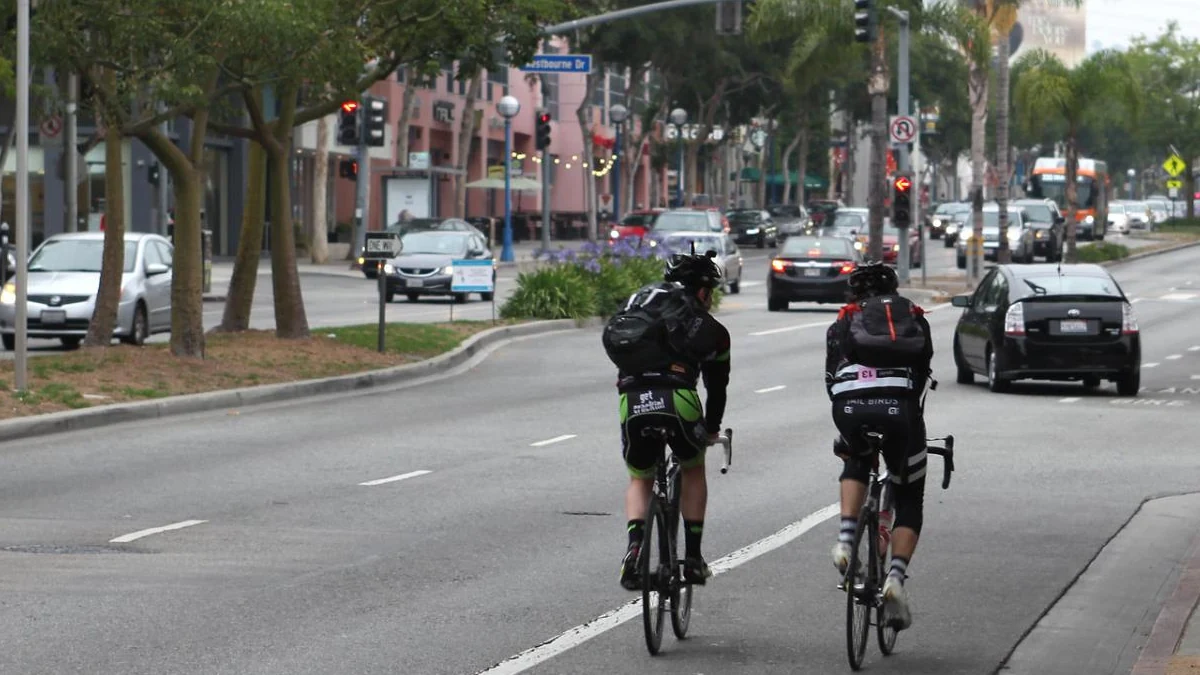
The majority faction on West Hollywood City Council bucked the passionate pleas of residents Monday night asking them to put the brakes on a plan to build protected bike lanes on Fountain Avenue, instead voting 3-2 to accept a multi-million dollar grant that will fund the project.
Vice Mayor Chelsea Lee Byers led Mayor John M. Erickson and Councilmember Sepi Shyne in siding with the bicyclist organizations who lobbied hard for the Fountain Avenue streetscape project, which will hand them lucrative contracts for outreach and marketing.
Erickson, weary of the public pushback, vigorously defended the plans.
“I cannot tell you how many times I have had great cups of coffee with my neighbors over watching someone who’s mangled get dragged out of a car, seeing a biker who’s been hit by a car, seeing a woman with her child have to walk on the road because the sidewalk is not wide enough,” Erickson recalled.
During discussion, the mayor addressed concerns about the project timeline and the engagement with emergency services, clarifying that while plans were still in development, the Fire Department would be consulted once the project had more concrete details. The mayor challenged the notion that the project was a “done deal,” explaining that the plans were still in the early stages and that community feedback would continue to shape the outcome.
City planners provided additional context, explaining that the Fountain Avenue project was still in the initial phase of planning and that more community outreach would be conducted before final decisions were made. They acknowledged the complexity of communicating effectively with the public about long-term projects and emphasized the importance of continued engagement with residents.
“Truth is important,” Erickson said. “What I heard being said by staff is that the project is not even anywhere near done yet. There’s still community outreach. The problem that’s happening is there is a lot of misinformation out there, and that’s unfortunate. People are being misinformed for whatever reason that serves their best interests. That’s okay. We’re all trying to live our lives and take in information where it is. For individuals that just found out about this yesterday — that’s unfortunate because we want to make sure everyone has all the facts because facts still matter in 2024.”
But Councilmembers Lauren Meister and John Heilman shared the reservations about he project held by many residents.
Meister raised questions about the composition of the steering committee responsible for the project, asking why the focus had shifted to sidewalks rather than the overall plan. The planners confirmed that the steering committee included a mix of professionals and residents, but there was some concern about whether all members truly represented West Hollywood, as one member resided in Los Angeles.
Meister questioned why additional members were being added after the initial phase, suggesting the original committee may have been biased toward pro-bicycle lane individuals. The conversation touched on the process for selecting members, whether public notice was given, and whether the city had followed the proper procedures outlined in their directions from previous meetings.
There was also concern about the involvement of the WeHo Bicycle Coalition in outreach efforts, particularly regarding its neutrality. The grant application indicated that Bike LA (BLA) would handle outreach, which raised questions, as the council had previously requested a neutral party be responsible for engaging the public. Additionally, the application mentioned that the identified population for outreach included seniors and disabled people. Meister asked how bike lanes would address the needs of these groups, particularly in light of the loss of 200 parking spaces.
City staff explained that outreach had been conducted in line with council direction and that the committee’s makeup included individuals with relevant skill sets, such as environmental consultants and sustainable planners. However, Meister argued that the process did not follow through on the promise to ensure a streetscape project was developed with input from all stakeholders, including those affected by parking loss.
The conversation also highlighted issues with transparency and communication, as Meister mentioned that longtime residents and homeowners were not included in the steering committee or notified about significant changes. Staff clarified that the city’s approach was based on earlier Council directions, and they had followed through with the plan as instructed.
Councilmember John Heilman summed up his opposition to the proposal thusly:
“I don’t want to say no to money from the state, but I don’t want to accept money with a commitment to implement bike lanes that I don’t support — and a lot of people in the community don’t support,” Heilman said. “There’s not resolution, and I don’t think in fairness we should go forward with that aspect of the grant money until we actually have a consensus within the community. This is a major, major change on Fountain. … I think telling people ‘you should just be unified and get on board’ doesn’t make sense and doesn’t take into account their legitimate concerns about this bike lane project.”
Byers sought to refocus the discussion as a positive development.
“I think in looking at it through the lens of streetscape redesign, of taking seriously the longstanding complaints we heard about Fountain, the dangers it holds, and this opportunity we’ve long sought to build this east-west route, Fountain becomes a perfect marriage of opportunity,” Byers said. “When you look around communities across the United States, around the world, that have made this transition, the increase in ridership is tremendous. … But getting on a bike to go all the way east feels like a challenge most days. I think when those of us who see and have that bike lane, we start to choose it.”
PUBLIC COMMENT
Genevieve Morrill, representing the Chamber of Commerce, expressed opposition to the proposed grant for the bike lanes on Fountain Avenue, citing the lack of outreach, data, and consideration of potential negative impacts on parking and businesses. Morrill stated that while they had initially supported the grant for multimodal transportation development, the absence of comprehensive data has left their position unchanged, as the presentation to their Government Affairs Committee lacked critical information. She reiterated that the Chamber cannot support the project without further clarity and data.
Tod Hallman, a former East Side Neighborhood Watch captain, explained that he had been asked by staff to write a letter of support for the project, believing it was merely for potential approval of a grant. Hallman claimed that he never endorsed the initiative and complained that his involvement has since caused him unnecessary political attention.
Kevin Burton, a representative of the West Hollywood Bicycle Coalition, commended staff for securing the competitive grant and emphasized its importance in funding a variety of projects like Vision Zero and bicycle lanes. Burton highlighted the city’s lag in implementing its 2017 Bicycle-Pedestrian Mobility Plan, mentioning that despite the plan’s approval, only minimal progress has been made. He stressed that this grant would help resolve funding challenges and create a more connected network of bike lanes, which would encourage more residents to bike around the city.
Laura Batti, a resident living near Fountain Avenue, opposed the bike lanes and offered a different perspective. Batti noted that West Hollywood is not like bike-friendly cities such as Amsterdam or Copenhagen. She shared her concerns about the lack of demand for bike lanes and the potential traffic disruption caused by their installation. Batti humorously commented on those who believe the bike lanes would lead to reduced car usage, suggesting that they may be overly optimistic. She also warned of potential increases in traffic on surrounding streets and the danger posed to pedestrians and cyclists due to displaced drivers seeking alternative routes.
David Eyer, another Fountain Avenue resident, also opposed the grant, expressing confusion about the specifics of the city’s agreement regarding the project’s requirements. Eyer emphasized the importance of transparency and noted that some letters supporting the grant had been proven invalid. He questioned the lack of community involvement in the early stages of the project, particularly the exclusion of Fountain Avenue residents. Eyer also critiqued the logic behind reducing lanes to lower emissions, suggesting that increased congestion would have the opposite effect.
Kimberly, a resident living just south of Fountain, raised concerns about the impact of the project on parking, particularly for residents of Hayworth House, a senior housing building with limited parking spaces. She pointed out the challenges caregivers and residents face in finding parking and emphasized that removing parking on Fountain would exacerbate the situation. Kimberly also highlighted the increased danger on side streets due to frustrated drivers speeding through residential areas and urged the Council to consider safety measures like traffic-calming solutions.
Stephanie Harker echoed the opposition, pointing out that while many residents support wider sidewalks and electric vehicles, there was no community support for bike lanes, particularly on Fountain Avenue. Harker noted that the $8.2 million grant application misleadingly claimed that the community backed the bike lanes. She emphasized that the project would remove 56% of street parking on certain stretches of Fountain Avenue, which was not disclosed to residents. Harker criticized the exclusion of residents from the steering committee and urged the Council to reconsider the grant application.
George Nickle raised concerns about the lack of consultation with emergency services regarding the project. Nickel shared that the assistant chief of L.A. County had not been briefed on the bike lanes and referenced the dangers reduced response times could pose in emergencies. He cited the tragic example of Paradise, California, where bike lanes impeded evacuation during wildfires. Nickel urged the Council to engage with first responders and reconsider the project’s potential impact on public safety.
David Lewis expressed confusion about the city’s parking policies. He recounted how, years earlier, the city proposed removing a park for parking, a suggestion he and his neighbors opposed. Now, the city seems to want to reduce parking by 60%. He voiced concerns about the project’s impact on local businesses, response times for emergency services, and the proposed bike lane on Garden Street, which he noted is a crucial route for emergency vehicles. He questioned the city’s lack of community consultation and the potential dangers the plan poses to public safety.
Brand Coffman took a different stance, emphasizing the need for change, even if it’s challenging. She pointed out that resistance to new transportation measures is nothing new, citing historical opposition to carpooling in Los Angeles. Coffman argued that the proposed changes, including bike lanes, would make streets safer and encourage alternative transit options, ultimately reducing greenhouse gas emissions. She criticized the focus on parking and traffic concerns, urging the city to prioritize safety and sustainability.
Sun Su, a nurse and longtime bicycle commuter, urged the council to support the project, emphasizing the importance of safety and mobility for cyclists and pedestrians. Su noted that public space should be used for public benefit, not to store private vehicles. She called for prioritizing transit, walking, and biking over single-occupancy car use.
Zekiah Wright expressed frustration over what they perceived as the predetermined outcome of the vote. Wright criticized the lack of community involvement in the planning process and pointed out that many of his neighbors were unaware of the project. While supportive of bike lanes in general, they argued that the current proposal is flawed. Wright, a candidate in the City Council race, ended by encouraging voters to elect new councilmembers who would listen to the community.
Mimi H., a Los Angeles resident, shared her positive experiences of biking in the city, despite the challenges. She supported the bike lanes on Fountain Avenue and other streets, describing them as a way to make West Hollywood more accessible and enjoyable. Mimi highlighted the potential of the new bike lanes to improve safety and promote healthier, more environmentally friendly transportation options.
Helen Kreer, a West Hollywood resident, shared her experiences living near Fountain Avenue. She described the dangers posed by speeding drivers and road rage incidents, even recounting a fatal altercation she witnessed. Kreer emphasized the need to redesign the street to make it safer for all users, including drivers, pedestrians, and cyclists. She urged the council to approve the project and reduce preventable deaths on the street.
Jordan Beard, another resident, echoed Kreer’s sentiments, emphasizing the need for safer streets in West Hollywood. Beard noted that the city’s current road design prioritizes cars at the expense of cyclists, pedestrians, and disabled individuals. They argued that the solution to traffic problems is not to add lanes but to encourage alternative transportation options. Beard supported the project, urging the council to reclaim the streets for the benefit of all residents, not just drivers.
Summer, a resident near Gardner Street, also supported the project. She shared their difficulties with biking on Fountain Avenue due to aggressive drivers and unsafe road conditions. Summer emphasized that the current design of Fountain Avenue treats it like a major street rather than the residential road it is. They expressed hope that the new project would make the street safer for both cyclists and pedestrians.
Claire Schmid, a long-time West Hollywood resident, spoke about the unsafe conditions on Fountain Avenue, including narrow sidewalks and speeding cars. She shared her desire to bike but expressed discomfort due to the lack of bike lanes. Schmid argued that protected bike lanes would not only reduce fatalities but also promote mental and physical health. She urged the council to accept the $8.2 million in state funding for the project, believing that West Hollywood has the potential to be more than just a city dominated by cars.
David Sarisan, a Fountain Avenue resident, voiced concerns about the lack of communication with the community regarding the project. He questioned the practicality of installing bike lanes on a street that sees 32,000 cars daily and highlighted the impact on traffic flow and surrounding streets like Sunset and Santa Monica Boulevards. While Sarisan supported the broader goals of the project, he felt disappointed by the lack of adequate consultation and communication with residents.
Cathy Blaivas, another speaker, focused on the integrity of the grant application, emphasizing that the community was repeatedly told there was no concrete plan. She pointed out that the grant application claimed there was community outreach and support, which she argued was misleading. Blaivas stressed the need for honest communication and outreach, especially concerning the potential loss of parking on Garden Street. She urged the council not to accept the grant under these conditions.
Henry Gilbert, an avid cyclist, supported the bike lanes, noting the dangerous conditions on Fountain Avenue due to speeding cars and inadequate bike infrastructure. He argued that the absence of cyclists on Fountain was due to safety concerns, not a lack of interest. Gilbert urged the council to prioritize people over parking and to accept the grant to improve safety for cyclists in the city.
Steve Breno and Steve Martin raised concerns about the consultation process and the potential loss of parking spaces. Martin, in particular, criticized the lack of involvement from Neighborhood Watch board members and the city’s reliance on “free money” from the grant. He argued that the project lacked proper studies and input from emergency services, and he predicted that residents would vote for new council members in November who would repeal the project. Martin also highlighted the significant loss of parking, which he believed would negatively impact residents.
Cynthia Blatt, a 32-year resident, criticized the grant application for internal contradictions and a lack of robust community outreach. She took issue with Mayor John M. Erickson’s comments about the grant being “free money” and expressed concern about the lack of detailed budgets, timelines, and data collection for the project. Blatt argued that the council’s responsibility was to serve the people who elected them, not to prioritize personal choices over community needs.
Rick Watts, another speaker, voiced opposition to the Fountain project, criticizing it for being driven by ideology rather than practicality. Watts questioned the lack of consultation with residents and raised concerns about the impact on parking and traffic, especially the possibility of diverting traffic from Fountain Avenue to already congested roads like Santa Monica Boulevard. He emphasized the need to consider the reality of a car-dependent culture, particularly for those unable to use bikes or scooters.