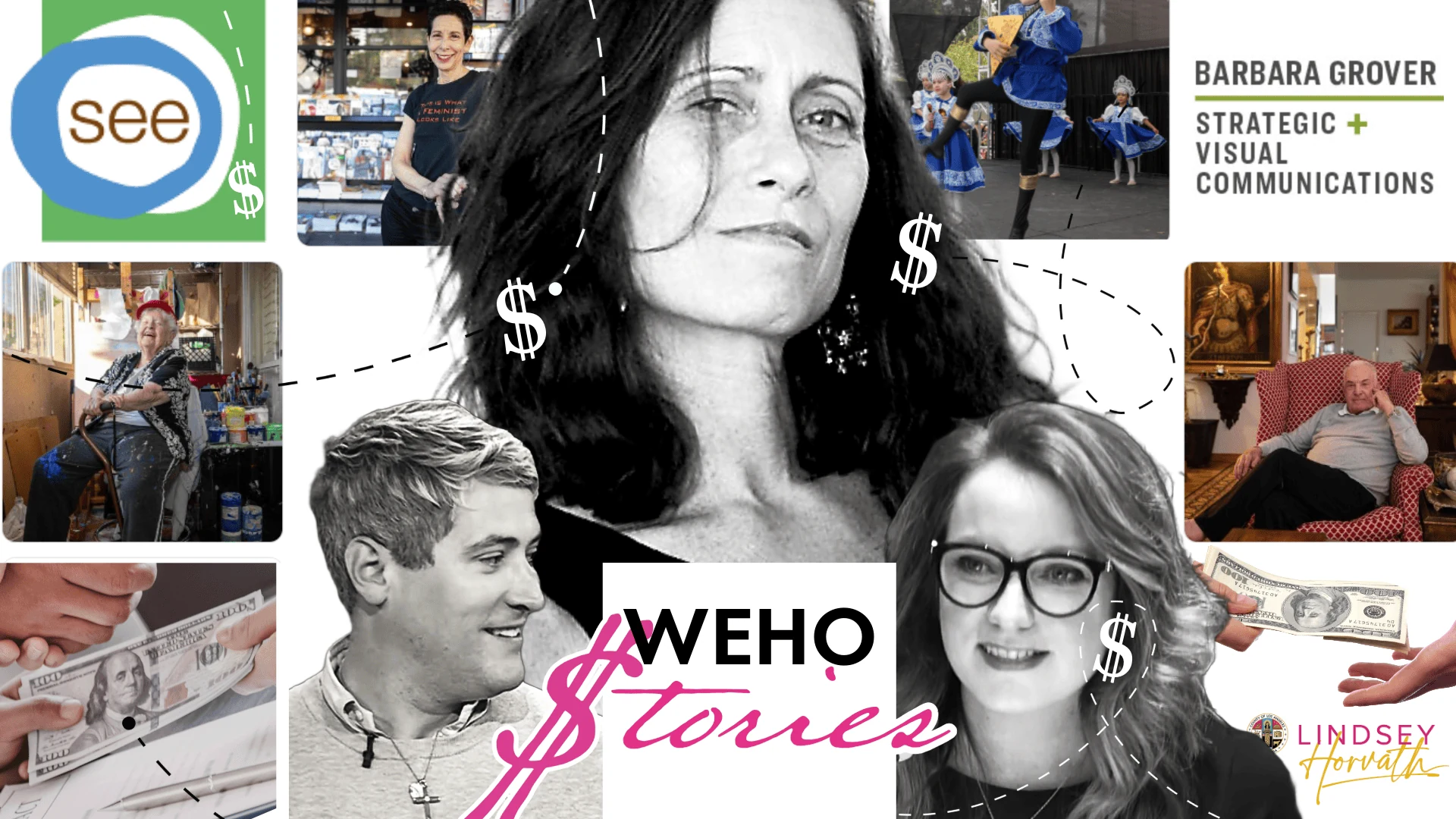
West Hollywood is planning to set aside up to $90,000 to resurrect a stalled city history project run by Barbara Grover, one of County Supervisor Lindsey Horvath’s closest political allies and a prolific campaign fundraiser, just in time to capitalize on the city’s upcoming 40th anniversary celebrations.
“WeHo Stories” is, according to City Hall’s oblique definition, “a community-driven project to document West Hollywood’s unique legacy and immortalize West Hollywood’s history.”
“Through first-person accounts and portraits of City founders, cultural leaders, activists, and stakeholders, WeHo Stories aims to highlight the City’s inspirational and informative history of diversity, landmark LGBTQ+ programs, and forward-thinking social and economic policies.”
But if you think WeHo Stories is just old timers and trips down memory lane, you’re not reading between the lines. This one-time pet project has grown into a golden cash cow, a pipeline for the county’s power brokers to repay favors, reward friendships and reap the benefits inherent in its sprawling network of shadowy funding sources.
Who owns WeHo Stories, who’s funding them and who stands to gain are as intriguing as the tale themselves.
Origin ‘Stories’
WeHo Stories launched in 2017, according to City Hall.
An article posted in this publication in 2020 was written by the WeHo Stories Founding Board, self-described thusly:
WeHo Stories was established to document West Hollywood’s unique legacy as a highly-acclaimed model city, incorporated in 1984. Internationally-published documentarian Barbara Grover is capturing the firsthand accounts and portraits of the city’s founders, its cultural leaders, and activists who banded together to realize the inspirational history of diversity, landmark LGBTQ programs, and forward-thinking social and economic platforms. Founding board members John Erickson, Alexander Gurfinkel, Lindsey P. Horvath, and Robert Kalonian believe immortalizing WeHo’s history in an accessible, first-ever collection will inform and inspire future generations of residents, policymakers, and stakeholders to engage with one another and their community, and strive for positive change.
Then-Councilmember Horvath raved about her brainchild in a 2018 press release announcing an upcoming fundraiser for the project.
“WeHo has an amazingly rich history and has consistently been at the forefront of the issues that we all care about,” Horvath was quoted in the release. “This is why I am excited about a project I have initiated, with the help of some truly incredible people: WeHo Stories. … Earlier this year, we formally kicked off our fundraising efforts. Tomorrow, September 11, I’m hosting a second event to raise seed money for this all-important project. I hope you can join us. If you are unable to be there, please consider making a generous donation to this important project.”
But WeHo Stories runs on a lot more than small donations.
The project operates under the 501(c)3 status of a nonprofit called Social and Environmental Entrepreneurs (SEE) that provides funds to more than 100 start-up organizations promoting left-wing/progressive causes such as climate change and criminal justice reform, including the Transforming Communities Initiative, which received ground funding from George Soros’ Open Society Foundations. SEE’s revenue exceeded $70 million in 2021.
This past December, SEE was selected by President Biden’s administration to serve as the EPA Region 9 Grantmaker. The organization received $50,000,000 under the EPA’s Environmental Justice Thriving Communities Grantmaking program, which President Biden’s Inflation Reduction Act created.
Despite Horvath’s fundraising and its tremendously wealthy nonprofit sponsor, very little of the WeHo Stories project has yet seen the light of day.
The 2020 article written by the founding board mentions setbacks from the COVID pandemic.
“Although the current pandemic precluded the in-person experience we had planned for the community as we came together to mark the anniversary of West Hollywood’s incorporation, we’d like to share a social media preview of a few of these portraits and the stories that they represent. We will share more photos and stories in the weeks and months ahead as we plan (and remain hopeful!) for a full launch in 2021. To see excerpts of some of these stories, visit us on Facebook, Twitter, or Instagram. (If you would like to be involved in bringing this project to life, please email us at wehostories@gmail.com.)”
WeHo Stories has pages on Instagram, X and Facebook which began posting in November 2020. Over the next two years, a couple of dozens posts appeared: random WeHo trivia, announcements and a series of promotional portraits. Activity ceased for unknown reasons in late November 2022 — just as Horvath began her transition from councilmember to county supervisor.
The promotional portraits feature familiar faces like current and former Councilmembers John Heilman and Abbe Land, and each is clearly labeled “All photos property of WeHo Stories © Barbara Grover.”
Who is Barbara Grover?
Officially, she is the “documentarian/archivist leading this effort,” according to the proposal, which describes her as an “internationally published freelance photojournalist, documentarian, and curator with a passion for distilling complex issues into accessible public education and empowerment tools.”
Grover’s connection to the political scene in WeHo and greater Los Angeles runs deep. She was involved in the campaign for cityhood and later served as deputy to original Councilmember Helen Albert.
She spent the decade between the mid-1980s and mid-1990s as a political consultant and partner at Skelton, Grover and Associates, working with campaign guru Parke Skelton to put a who’s who of local elected officials in power.
More recently, Grover was hired to lobby on behalf of an earlier version of the 8850 Sunset Blvd. (Viper Room) project, loathed by residents at the time.
Barbara & Lindsey
Over the past seven years, a pattern of mutual generosity has emerged between Lindsey Horvath and Barbara Grover, including a series of financial transactions known formally as behest donations. These controversial arrangements are largely forbidden for L.A. City Councilmembers; the L.A. Times characterizes them as a “toxic pay-for-play culture.”
During the period between December 2018 and June 2019, a $15,000 donation was requested at the behest of then-Councilmember Horvath from Margot Siegel, a prominent former architect and a philanthropist whose husband was an important figure in the history of West Hollywood. (Margot is featured among the promotional portraits posted to WeHo Stories social media).
It was the largest single donation made at the behest of a City Councilmember in that period.
The $15,000 donation Horvath requested from Siegel went to none other than Social & Environmental Entrepreneurs (SEE), the non-profit sponsor of WeHo Stories. Meanwhile, Grover’s company, Barbara Grover Inc., received $27,000 from West Hollywood United to Support Lindsey Horvath and John D’Amico for Council 2019, a political action group formed to campaign for Horvath’s re-election to City Council in 2019.
Horvath also behested a donation of $3,000 from Liberty Hill foundation to SEE to support WeHoStories.
In 2022, “Neighbors for Lindsey Horvath,” an independent expenditure committee supporting the campaign of Lindsey Horvath for LA County Supervisor, raised over $60,000 in its first couple of weeks thanks to fundraising phone calls made by Grover along with then-Councilmember Erickson.
The Next Chapter
The tangled cash trail of WeHo Stories now leads back to WeHo City Council chambers, where the councilmembers on Monday will decide whether to allocate up to $90,000 to the project.